
Special reports
The ultimate buyer’s guide to hotel revenue management systems 2026
1. What is a hotel revenue management system?
A revenue management system (RMS) automates the process of using analytics to determine the right price for hotel rooms to maximize revenue and profitability. The primary goal is to sell a product to the right customer at the right time for the right price on the most suitable channel.
Revenue management software ingests historical and market data, combines this with forward-looking demand signals and recommends a rate for each segment and room type at your hotel, specific for each channel on which you are selling.

RMS use cases
Drive more value
An RMS helps hotels determine how much to charge for their rooms each day. By accurately pricing hotel rooms based on real-time supply and demand data, hotels can drive average daily rate, revenue and most importantly RevPAR index.
Forecast demand accuracy
A good RMS will detect changes in demand and potential guests’ sensitivity to price, and build a more accurate demand forecast based on actual activity in the market.
Create operational efficiencies
Automating your revenue management with an RMS means hoteliers no longer have to build spreadsheets and reports, calculating the demand by hand every day, and then entering those numbers into a spreadsheet and reporting system. This frees revenue professionals up for more strategic thinking around positioning their hotel in the market.
How an RMS adds value
Set and optimize prices
Hotels that switch onto a revenue management system generally experience a RevPAR increase of between 5-20% as a result of optimized automatic price setting per room type.
Streamline and automate manual workflows
Hotels that use RMSs save between 20-40 hours per month by streamlining manual workflows. An RMS also serves to visualize complex data sets into an easy to use and easy to understand user interface that saves revenue managers from difficult manual calculations and cumbersome spreadsheets.
Leverage large data sets to enable complex decision making
Transitioning to an RMS means hoteliers no longer have to build spreadsheets and reports, calculating the demand by hand every day, and then entering those numbers into a spreadsheet and reporting system. This frees revenue professionals up for more strategic thinking around positioning their hotel in the market.

There’s a wide variety of accommodations in the hospitality industry — from cozy boutique hotels to all-inclusive brands operating across multiple countries — each with its own operational challenges and opportunities.
The good news? There’s an RMS built to meet every need. Here’s how to find the right one for yours:

Boutique and independent hotels
Operational efficiency: Low, usually managed by 1–2 people
Independent and boutique hotels face unique challenges – diverse room types, fluctuating demand and lengthy processes. Without the right tools, revenue opportunities often go untapped. An RMS empowers you to grow margins, simplify workflows, and elevate the guest experience.
What's needed
- Intuitive RMS with visual dashboards
- Automated rate updates, reporting, and revenue rules
- Real-time pricing recommendations
- Rapid onboarding and support
- Seamless OTA and booking engine sync
⭐️ Success story: Room-type strategy drives revenue for Hotel Peter and Paul
Large hotels and resorts
Operational efficiency: High, with department silos
For large hotels and resorts, revenue management can get complex — juggling seasonal demand, multiple revenue streams, and varied guest expectations. An RMS becomes your financial brain, guiding smarter pricing decisions, balancing channel mix, and driving profitability across departments.
What's needed
- Real-time pricing recommendations
- Rate adjustments by stay date, distribution channel, room type and customer segments
- Maximize room and non-room revenue streams
-
Optimization for group and event business
⭐️ Success story: Mexican resort adopts data-driven revenue strategy
Budget and economy hotels
Operational efficiency: Medium, often franchise branded
Budget and economy hotels operate with high-volume and low-margins. They don’t need fancy features — they need a system that’s fast, reliable, and focused on filling rooms efficiently. The ideal RMS is lightweight, automated, and delivers instant insights that help keep occupancy high and operations lean.
What's needed
- High-speed rate updates
- Pre-built pricing templates
- Easy, visual reporting
- Automated rate updates and revenue rules
- Real-time pricing recommendations
- Quick setup and onboarding
⭐️ Success story: Lub d sees rates treble in high season
Extended stay
Operational efficiency: High, with department silos and high-touch experience focused
Extended stays play by their own rules: fewer booking turns, longer lead times, and more complexity. An automated RMS helps you adapt quickly, respond to market shifts, and capture every revenue opportunity — all while maintaining a premium guest experience.
What's needed
- Automated rate updates, reporting, and revenue rules
- Real-time pricing recommendations
- Balance group and transient bookings
- Tech stack sync for full connectivity
⭐️ Success story: Sunshine Coast hotel boosts revenue by $210K
Casino resorts
Operational efficiency: High, high-touch experience focused
Casinos operate in a world of their own — where every guest touchpoint is a revenue opportunity. With an advanced RMS, you can connect the dots between gaming, F&B, entertainment, and rooms, turning insights into powerful pricing and loyalty strategies that boost total guest value.
What's needed
- Real-time pricing recommendations
- Advanced segmentation
-
Integration of loyalty insights with pricing
-
Total guest value optimization
- Advanced forecasting accuracy
-
PMS sync
⭐️ Success story: Choctaw Casinos & Resorts: A decade of revenue growth
Total profit optimization
As revenue strategy evolves beyond rooms, revenue managers are turning toward total profit optimization. The key shift is visibility—not just into top-line revenue, but into profitability across every department. That means tracking GOP, flowthrough, and departmental margins, then linking revenue decisions directly to bottom-line impact. The next generation of RMS will be judged by how well it connects commercial strategy with true profit outcomes
The rise of AI-powered contextual guidance
AI isn’t just about automation — it’s about adding real-time context to decision-making. With Large Language Models (LLMs), RMS platforms are beginning to support natural language interactions, giving revenue leaders faster, tailored insights through simple dialogue instead of click-and-search workflows. The next leap is Agentic AI: systems that don’t just recommend, but act. This opens the door to dynamic pricing across all revenue streams, along with automated decisions on distribution, channel mix, and cost of sales—all grounded in profitability.
From guest experience to guest activation
For today’s commercial leaders, growth isn’t just about winning the booking — it’s about shaping every revenue moment along the guest journey. The focus is shifting from vague “guest experience” talk to precise, profit-driven interventions: personalized pricing, targeted upselling, and demand-based offers delivered at the right time. The goal is clear — optimize revenue per guest, not just per room.
5. Selecting the ideal RMS provider
Open Pricing
Your RMS must be able to price room types and channels independently of each other, rather than in lockstep with a set BAR price. For example, on some days you want your AAA rate to be 10% less than BAR, on other days you may want it 1% less than BAR.
Real-time price automation
With real-time price optimization you take advantage of even the slightest changes in the market or your internal data to maximize your property’s revenue. By automatically retrieving and analyzing internal and external data your RMS updates a hotel’s room rates in real-time.
Automated recommendations
With the push of a button, your price recommendations will instantly be reflected in your PMS. Neither analysis nor manual updates are required. Choose between accepting your recommendations one by one, in bulk or even override specific recommendations.
Profitability insights
Advanced RMSs look beyond revenue to focus on true profit. By combining booking data with external benchmarking, they help you compare performance with the market, identify profit leaks, and fine-tune pricing and operations to maximize margins.
Data visualization and intelligent reporting
A good RMS not only presents your data in tabular reports, but allows you to visualize your data and reports in graphical form. This allows revenue teams to better understand trends, outliers and patterns in data. It’s important that your RMS is able to build, export and share your most critical reports.
Price sensitivity charts
When setting the room price you need to take both internal and external data into consideration. The Price Sensitivity Chart is a graph illustrating the current optimal room price in relation to change in revenue and occupancy rate. It helps you to make sure your price points are accurate.
Meeting and events optimization
This module enables you to forecast demand and optimize pricing for meeting rooms, event spaces, and related services, ensuring you maximize profitability from all revenue streams, not just rooms
Group pricing and displacement analysis
A robust RMS with group pricing feature not only calculates the optimal group rate but also performs a displacement analysis, assessing whether accepting a group booking would prevent higher-yield individual bookings and helping you determine the minimum acceptable group rate.
Cloud technology
An RMS that runs on multi-tenant cloud architecture allows your systems to integrate and share data more seamlessly, and allows developers to push updates to your software in real-time. No more purchasing new versions of software just to get the latest features.
Duetto is an amazing RMS and the people there are top notch!
Cornelio Encarnación who is the director of customer success for the LATAM region, and the one who's assigned to our property is simply wonderful, he's been helping us a lot since we started working with Duetto. The platform is also very user friendly and it has a ton of functions which have made our day-to-day operations runa lot better.
Duetto is great and convenient
Using Duetto has been very beneficial in the day-to-day of revenue management. I like that I can easily compare and see save time in seeing data from LY and etc.
Duetto is a really powerful and easy-to-use tool for hotel revenue management
The integration with my existing systems was smooth, which made the transition seamless. Overall, I highly recommend it for anyone who wants to automate their revenue strategy. The system offers very flexible options to control rates and availability. Very useful options such as automatic pricing and restriction strategies.
Duetto is the most intuitive RMS
Friendly user RMS with various interface options, that gives you the possibility to automate yielding on the level of property and room type. Easy to navigate and report possibilities that gives you a range of various metrics where you can easily set up custom made reports. Last, but not least, reliable support.
Throughout my long career, I have had the privilege of working alongside many outstanding companies. However, it is truly rare to encounter a group like Duetto. Their professional expertise is not only widely recognized in the industry, but what truly sets them apart is the unwavering support and sincere appreciation they show toward their partners. It is not just about doing business! It is about building meaningful relationships.
Christian Pirodon, Founder
Duetto's RMS leverages advanced AI for dynamic pricing and demand forecasting, offering unparalleled flexibility and real-time insights. Unlike others, its Open Pricing model optimizes every segment, channel, and room type for maximum revenue
Fabio Leon Hoffmann, Sales Executive
Its ability to automate pricing adjustments, optimize revenue, and free up resources for strategic planning, its reputation for delivering reliable, actionable insights through an intuitive, user-friendly interface, and its ability to manage complex pricing structures across multiple properties.
Rodrigo De Landa, Sales Director
7. Kickstart your journey
Follow these simple steps to begin your process and find the best RMS for your hotel.
👉 Access our full request for proposal (RFP) guide for an in-depth walkthrough and ready-to-use templates.
1. Prepare your vendor questionnaire
Once you’ve assessed your current situation, defined your RMS requirements, and prepared a questionnaire, send it to a shortlist of vendors to compare their solutions.
💡Tip: Use our step-by-step checklist to make sure you’re covering all the essentials.
2. Ask the right questions
Ask your vendors key questions such as:
- Can the software price room types, segments and channels independently of each other?
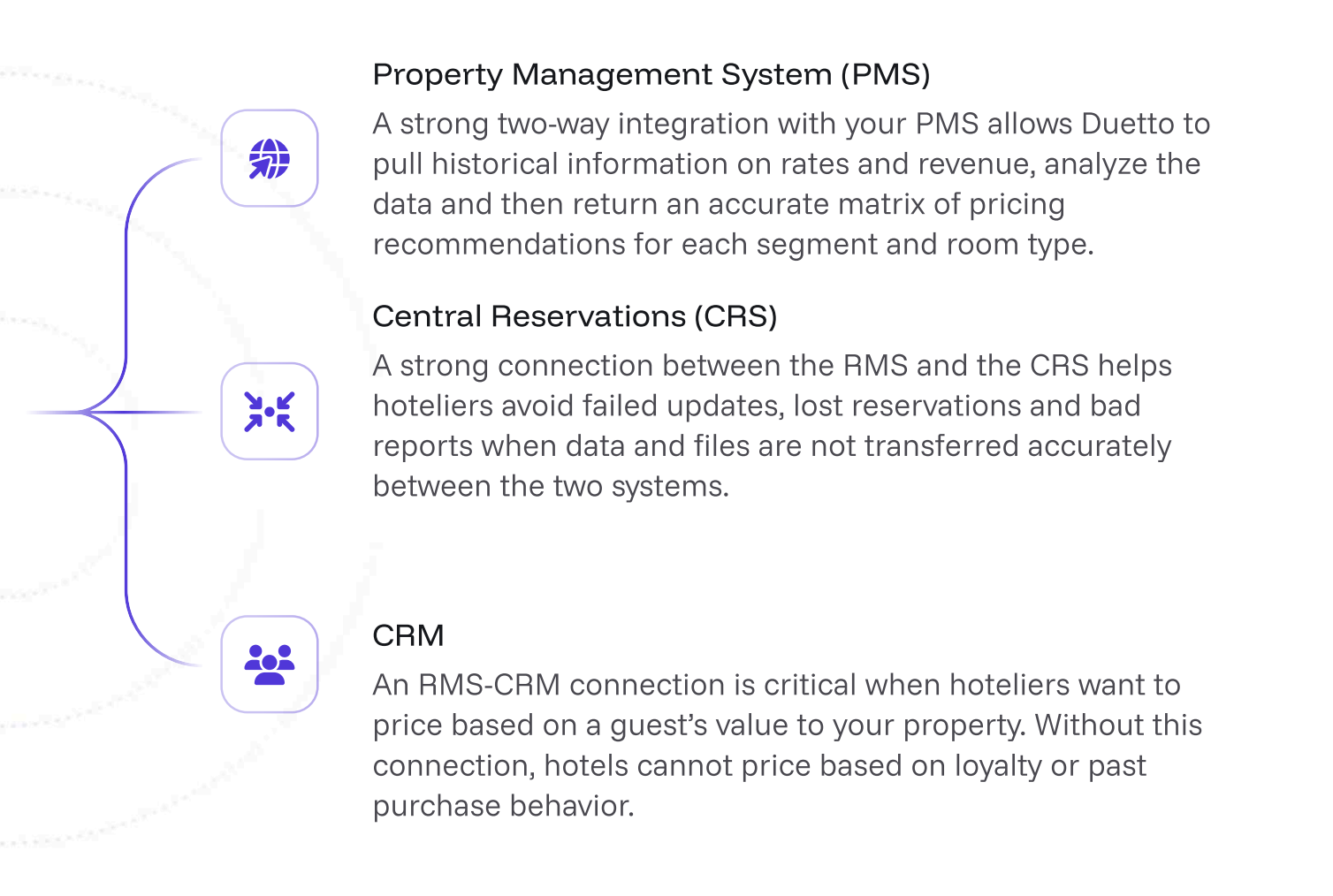
- Will the RMS integrate with my PMS, CRS, CRM and booking engine?
- What kind of data shapes the pricing algorithm?
We’ve created a ready-to-use questionnaire template with the most common and critical questions to save you time.
Once you have the responses, organize them in a comparison matrix—score each answer, weigh them by importance, and summarize your findings in a 1–2 page overview.
✨ Pro tip: Use our matrix template to get started faster.
3. Compare pricing quotes
Create a price comparison matrix that includes one-time initial fees, fees for year 1, and fees for year 2, broken down by annual, periodic, and transaction fees. Showcase the total charge for each item, which may vary depending on your hotel size. At the bottom of the summary, group these fees and include a grand total of the three subtotals.
4. Make your final selection
Schedule demos and Q&A sessions with your finalists to see each solution in action. Then, negotiate pricing, contract terms, SLAs, and onboarding timelines.
Set up your implementation team, plan your internal communication and training, and define what success looks like for your property — whether that’s RevPAR, Profit, or RevPAR Index.
⭐️ Success story: See how Jannah Hotels & Resorts achieved a 22% RevPAR increase across their UAE-based portfolio after adopting Duetto's RMS.