

















Every rate a hotel publishes is a call on demand: who is still going to book, what they will pay, and how many rooms are left to sell them. Pickup has always been one of the strongest signals for making that call, and it still is, but demand shows up in more places than booking pace, and a rate should account for all of them.
That is what our latest pricing is built to do.
It weighs a broader set of demand signals alongside pickup, understands how much you have left to sell, and tells you why it landed where it did.
It reads more of the market.
Duetto’s pricing now considers seasonality, how many days are left before arrival, and what your competitors are charging, all alongside your pickup and booking pace.
What matters most is that it doesn’t weigh those signals the same way for every hotel. It learns how much each one matters for yours, rather than following a fixed rule.
It knows what’s left to sell.
Demand only means something against what you still have to sell. So two more things shape every recommendation:
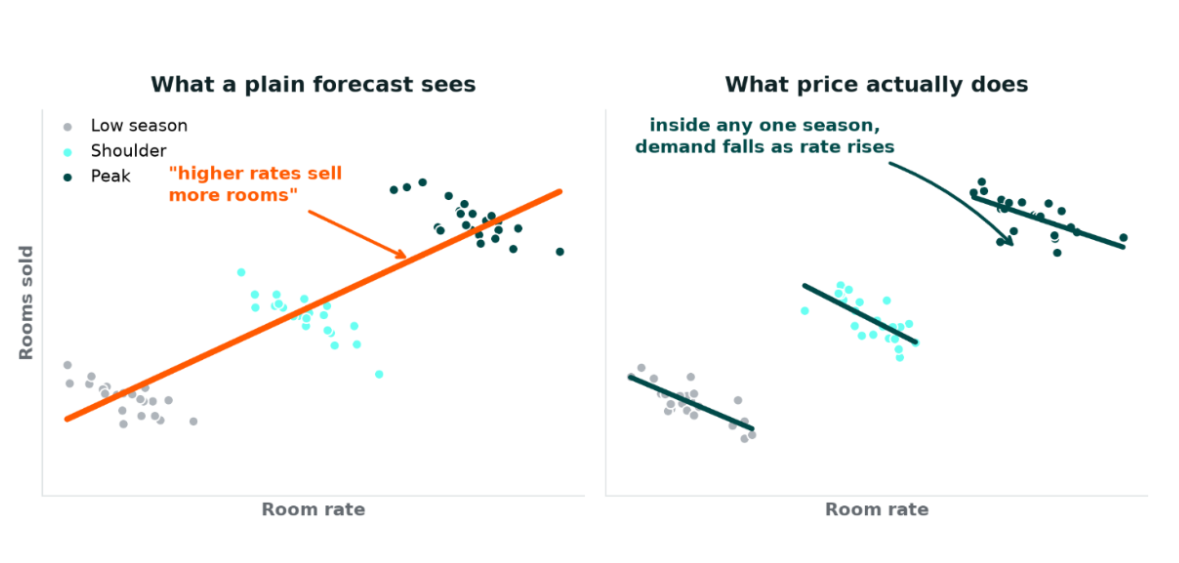
Price sensitivity
How willing guests are to book at a given rate on a given night. Pricing estimates that response night by night.
Sellable capacity
The rooms genuinely left to sell once groups and expected cancellations are accounted for, along with the chance the hotel sells out.
Together, they let pricing tell apart nights that look identical on pickup. When little is left and a sellout is likely, it raises the rate and saves the last rooms for guests willing to pay more. When rooms still need to move, it holds the rate or lowers it.
It shows its reasoning.
A recommendation is only useful if you trust it enough to publish it, so we’re putting the reasoning next to the rate.
Rate explanations are rolling out on the Manage Rates page, giving a short, plain-language reason behind a recommended rate. You can give each explanation a thumbs up or down, and that feedback shapes what we build next.
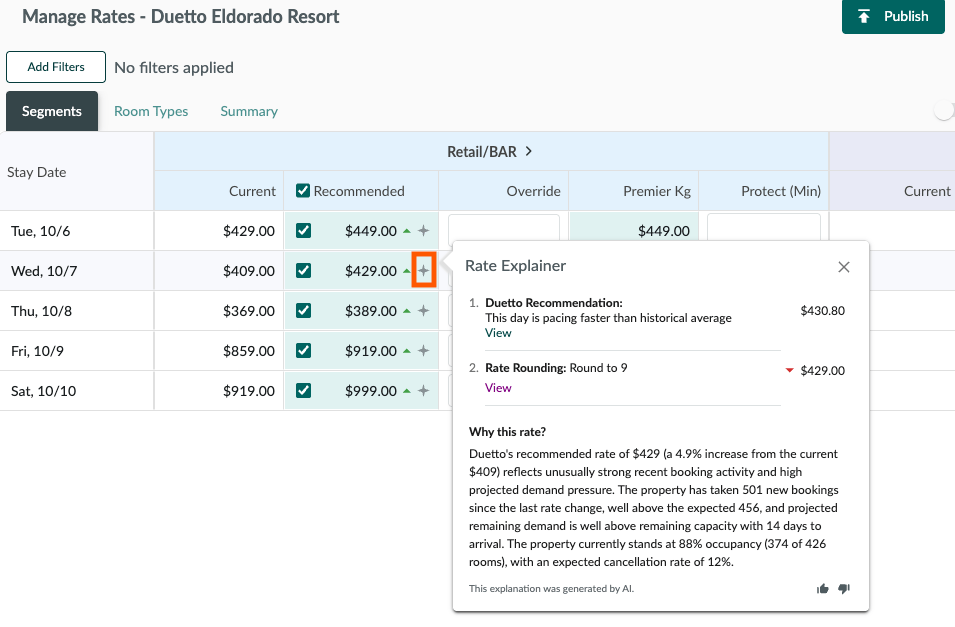
Rate explanations on the Manage Rates page.
Built alongside the forecast.
Anoushka Shahane recently wrote about Duetto’s new forecast. Pricing and forecasting are built to work side by side, and each is designed around a different question.
The forecast is tuned to predict, as accurately as possible, how many rooms will book. Pricing is tuned to decide what those rooms should cost, which means it also has to understand how guests respond to price.
One tells you what’s coming. The other decides what to do about it.
Both learn from each hotel’s own history, and both are built to improve as they see more of it. A sharper view of demand and a sharper rate serve the same end: capturing the revenue that is actually there.
How we built it to work for you.
Our latest pricing:
Learns from each hotel’s own booking history.
No two hotels book the same way, so no two hotels are priced by the same fixed logic.
Starts close to how your hotel already prices.
The first thing you should notice is a better-informed rate, and it should still feel like yours.
Works inside your rules.
Your minimum and maximum rates, your strategies, and the way you review and publish rates all stay as they are.
What comes next?
These updates are now live and we’re continuing to roll them out over the coming weeks to our customers.
And we’re not done improving pricing. Here’s what’s coming: