



%20(1).jpg?width=800&height=640&name=bda7526721e09775ea83bad9a4a46d890c32c459-(2)%20(1).jpg)













.png?width=299&height=165&name=Duetto_Generic_Icon_12_Midnight_Green%20(1).png)















Revenue management isn't the same job it was even a few years ago. The role has stretched well beyond forecasting and pricing into territory that touches marketing spend, guest experience, and the P&L as a whole. Today we're going to dive into exactly how revenue management careers and roles are evolving and how building profit-centric skills can accelerate performance and strengthen career longevity. We'll also cover how revenue managers starting out can build this thinking into their careers from day one.

How revenue management careers are changing.
Revenue management has always been a demanding discipline, one built on reading demand, setting the right rate at the right time, and protecting a hotel's top line in a market that never holds still. RevPAR has sat at the center of that work for good reason: for a long time, if you grew RevPAR, you grew profit right alongside it. The two moved together closely enough that watching one was, in effect, watching both.
That's no longer guaranteed. Costs have risen. Labor is harder to predict. The market shifts faster than budgets can keep up with. Two hotels can post identical RevPAR and land in very different places on profit, depending on how that RevPAR was earned, where the bookings came from, and what it cost to deliver them.
Volatility and rising costs are the constants now, and the only reliable way to weather that is to build your strategy around profit itself, not just the revenue that leads to it.
None of this makes RevPAR irrelevant. It's still a critical signal. But on its own, it can no longer tell you whether a decision is actually good for the business. Profit is where that answer lives, and it's where decision-making needs to center.
Enter performance engineering.
The hotels pulling ahead share a pattern: they've put profitability at the center of their overall strategy and way of operating. Duetto has defined a name for this new way of working: performance engineering.
Performance engineering isn't a new job title, and it isn't a piece of software. It's a discipline: a way of running the commercial side of a hotel so that every decision, in every department, is weighed against what it actually delivers to the bottom line.
It changes the central question revenue teams are working from. Instead of "what rate should this room be?", the question becomes "what should this hotel be doing, across pricing, group strategy, guest spend, and forecasting, to actually drive profit?". That's a much bigger question than any one rate, and that's the point. Performance engineering shifts the focus from managing a single metric to managing overall hotel performance, so that every team is working from the full picture, not just their slice of it.
The four shifts of performance engineering.
Adopting this approach means shifting four things at once.
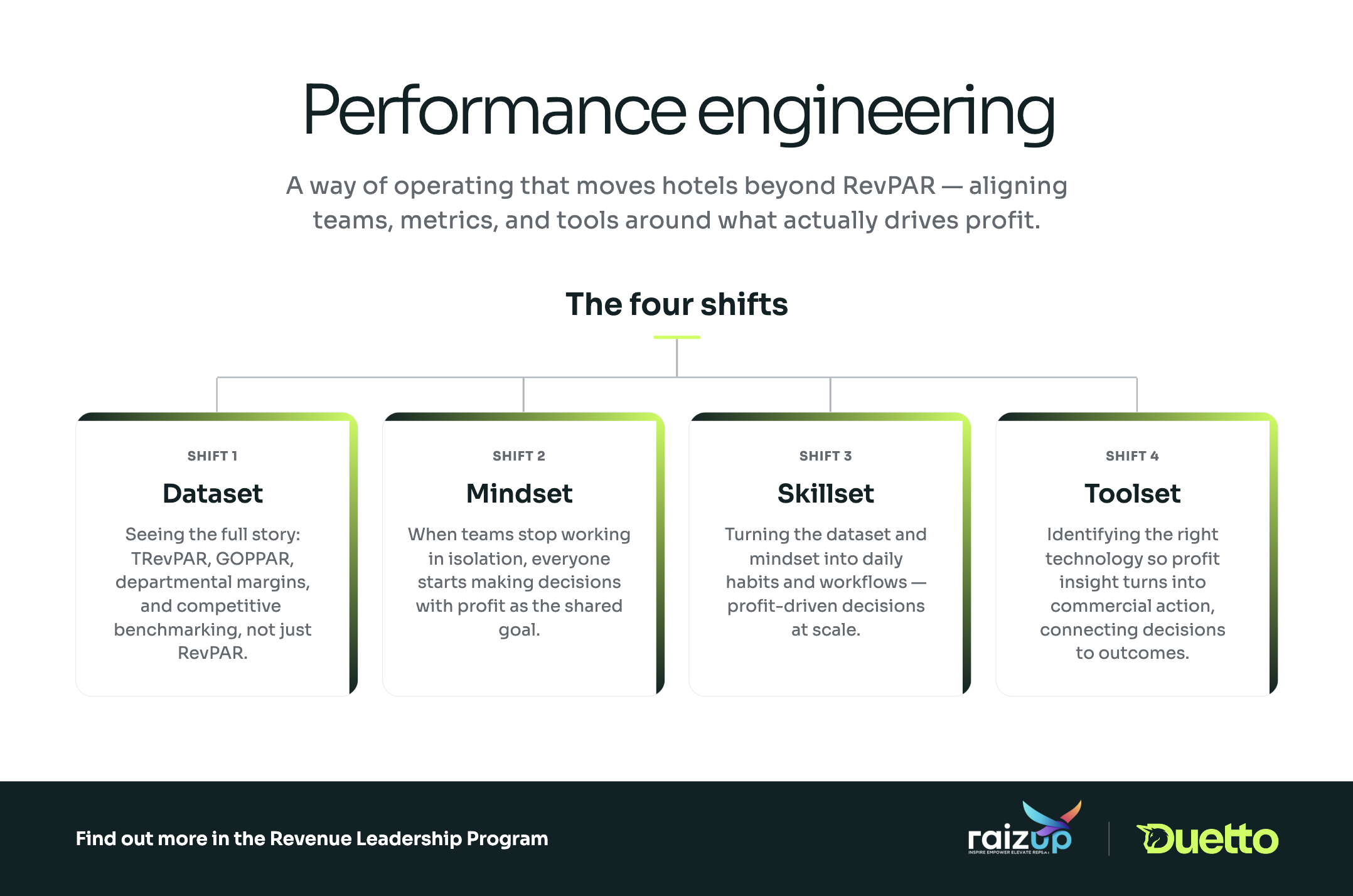
A wider dataset. To engineer performance, you need to look at profit-focused metrics. This means incorporating the following into your regular reporting, on top of RevPAR:
- GOPPAR — gross operating profit per available room
- TRevPAR — total revenue per available room
- CPOR — cost per occupied room
- GOP Index — how your gross profit performance benchmarks against your competitive set.
You can also benchmark all of the above against your competitive set and your local market, to give you a good idea of how your profit reality compares.
A shared mindset. Profit can't be one team's job. It needs to sit at the center of how every team that can affect the bottom line operates and how every individual thinks. Not just revenue and finance, but sales and marketing too.
A marketing team, for example, still needs to watch conversion rates, but performance engineering asks them to also weigh how much a channel or campaign costs against what it brings in, so a "successful" campaign on its own terms doesn't quietly erode margin. The same logic applies wherever a team's decisions touch profit, even if profit isn't the metric they're used to reporting on.
Profit is the North Star, and wider team alignment is what makes the shift stick.
Turning insight into action. Having the right data and the right mindset only matters if it changes what teams actually do day-to-day. This shift is about building habits and routines, like reviewing GOPPAR alongside RevPAR, or bringing revenue, operations, and finance into the same conversation with the same numbers in front of them, so profit-focused thinking shows up in daily decisions.
The right toolset. More metrics to handle means it’s even more crucial to have the right technology to make optimizing for performance possible at scale. Performance engineering requires tools that connect commercial decisions to their profit outcomes, show you how you're performing against the market, and surface what needs attention before it becomes a bigger problem. They should also automate more straightforward decisions, so revenue leaders have more time to interpret insights and turn them into action.
Duetto's Revenue & Profit Operating System is a strong example of tools that can bring this all together: it connects pricing, forecasting, group strategy, and demand data with HotStats' profit benchmarking, so commercial teams can see not just what happened, but what it meant for the bottom line and what to do next. It's built to be a system you act from, not just one you check in on.
Where this leaves revenue leaders.
With a performance engineering approach — the job of revenue management starts to look different. It becomes centered around whether the hotel, as a whole, is performing the way it should be, and having the visibility to answer that with confidence.
That kind of visibility doesn't belong to any single role. But it does call for a particular kind of revenue leader: someone fluent in profit, not just pricing, and able to bring the rest of the commercial team along toward the same goal.
Practicing performance engineering also ensures you’ll be a leader built to last. Hotel ownership changes hands and portfolios grow and get restructured.
Through all of it, a commercial leader who can speak fluently to profit, and show a track record of protecting it, is the one who stays valuable to whoever's holding the asset next.
The development challenge of performance engineering.
Knowing what performance engineering demands, now the challenge is building the capability to practice it.
The shift from metric manager to commercial architect doesn’t happen through experience alone. It requires deliberate development across a specific set of capabilities that traditional revenue management roles rarely build systematically: cross-functional influence, profit fluency, data-driven decision-making, and the leadership presence to bring other teams along. You may accumulate some of these skills gradually on the job, but at some point they need to be built intentionally.
The hospitality sector has traditionally been hesitant to address this developmental gap. Conventional training pathways remain anchored in the tactical: interpreting pickup reports, constructing forecasts, and navigating pricing strategies for high-demand periods. While these technical fundamentals are indispensable, they fall short of preparing a professional to command a boardroom dialogue regarding acquisition costs, interrogate a marketing channel's impact on margins, or re-engineer cross-departmental data architectures.
Historically, the transition from being a skilled technician to a genuine commercial architect has been a matter of fortune — dependent on fortuitous mentorship or prolonged cycles of trial and error in varying environments.
This represents a systemic failure rather than a personal one, and the consequences are becoming more apparent. Organisations that fail to convert high occupancy into meaningful profit often possess the necessary technology and datasets, yet lack the leadership presence required to synthesise them into a cohesive strategy. While performance engineering provides the conceptual framework for a solution, merely identifying the discipline needed is insufficient. The industry requires a rigorous, intentional methodology to cultivate this high-level commercial talent at scale.
And that is the gap that Duetto and RaizUp are set out to close: Duetto, through its continued education on performance engineering, and RaizUp, through its Revenue Leadership Program (RLP). To facilitate this, Duetto will be sponsoring this year’s RLP and will be bringing its thinking on performance engineering into several core sessions.
What the RLP develops.
The RLP is an eight-week online programme for senior hospitality professionals who are ready to move beyond the mechanics of revenue management and into genuine commercial leadership. Across 25 sessions and four verticals, it builds the capabilities that performance engineering actually requires in practice.
Revenue Strategy, Total Profit & Distribution. Success in this vertical means moving beyond basic RevPAR to master Total Revenue Management and profit-centric benchmarks. It is designed to foster a deep-seated mindset shift where delegates internalise full P&L responsibility and apply cross-sector insights to their commercial decisions.
Guest Experience & Digital Marketing. Effective performance engineering hinges on a leader's ability to link loyalty strategies and channel mixes directly to bottom-line margins. This module builds the essential commercial literacy required to manage the full guest journey while protecting acquisition costs.
AI, Innovation & Technology. Modern performance engineering is powered by technology, but its value lies in strategic application. We focus on the critical balance of digital transformation: knowing when to rely on automation, how to interrogate complex data sets, and when to apply the human judgment that software alone cannot provide.
Leadership, Career & Personal Development. This final vertical bridges the gap between technical expertise and genuine commercial leadership. It equips engineers with the influence to drive change and foster a data-driven culture across hybrid and remote teams, ensuring they have the presence needed to bring the entire organisation along.
The operating framework in practice.
Performance engineering is not a hypothetical way of operating for the future. It represents a fundamental shift already being championed by the most impactful commercial leaders in the industry. High-performing hotel teams and organizations are actively transforming their practices in this direction, even if they haven’t yet settled on the terminology.
The distinction for these professionals lies beyond mere technical proficiency. It is the capacity to master the total commercial landscape: interpreting a profit signal to identify the precise strategic lever, translating complex datasets into a unified narrative for sales, marketing, and finance teams, and cultivating an organisational culture where profit-centric thinking is woven into the fabric of daily operations rather than reserved for retrospective reporting.
Adopting this approach requires a willingness to operate at the perimeter of traditional functional boundaries. Performance engineering practitioners anticipate margin erosion within the data long before finance issues an alert, arriving at the boardroom with a proactive solution already in hand. Rather than reacting to group strategies in hindsight, they engage as a primary stakeholder, interrogating the true cost of delivery before commitments are made. This high-level, cross-functional presence is the hallmark of a commercial architect whose value transcends technical proficiency.
Hotels that secure this caliber of leadership do more than just exceed financial benchmarks; they cultivate an environment where decisions are accelerated, and departmental silos are dismantled. When market volatility strikes, these organizations move with greater conviction.
The compounding advantage of a leader who can synthesize complex data into strategy, influence across the enterprise, and pivot the entire team toward a profit-centric standard is a competitive edge no technology can replicate on its own.
Closing this development gap is why the RLP exists. It moves beyond abstract theory, utilizing live interactions with market leaders, practical application, and collaborative learning within a high-level cohort of up to 70 global peers to build a professional network and a skillset that remains relevant long after the program concludes.
Where to start.
Should the performance engineering framework detailed above align with your vision, and if the disparity between current revenue operations and future commercial necessity feels familiar, the RLP offers a definitive path forward. Duetto also continues to share its definitive thinking and practical tips for performance engineering here.
The fifth RLP cohort commences on 20 October 2026, with Early Bird enrollment currently accessible. Duetto will be sponsoring this cohort, and will be delivering several sessions. All participants will also receive a ‘Duetto Certification’ as part of the course.
Review further details and secure your position at weraizup.com/revenue-leadership-program.
.png)