



%20(1).jpg?width=800&height=640&name=bda7526721e09775ea83bad9a4a46d890c32c459-(2)%20(1).jpg)













.png?width=299&height=165&name=Duetto_Generic_Icon_12_Midnight_Green%20(1).png)















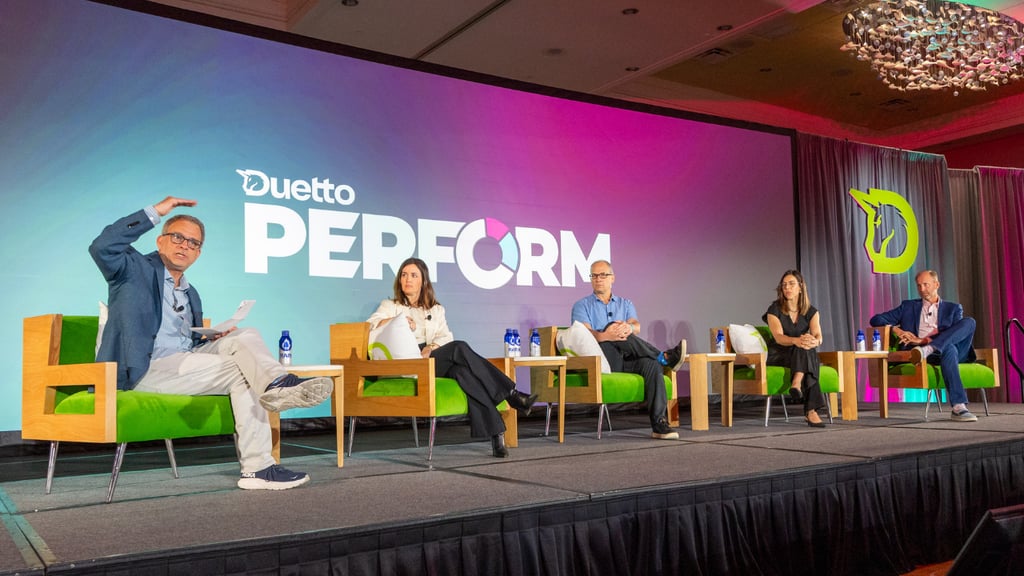
At PERFORM, our global summit for revenue and profit, five senior hospitality leaders discussed what the shift to profit thinking actually looks like in practice for hotels, and how you can do the same.
The room rate is not your problem. It never was.
That was the consensus running through our panel ‘How hospitality leaders are winning now’, featuring:
- Chris Cylke, President and Chief Operating Officer at REVPAR International
- Irene Villafranca, Vice President Commercial Strategy and Systems at Minor Hotels Europe & Americas
- Michael McNames, Senior Director of Revenue Management and Distribution at The Sandman Hotel Group and Sutton Place Hotel Company
- Katie Moro, Vice President, Data Partnerships, Hospitality at Amadeus
- Glenn Haussman of the No Vacancy Podcast as our moderator
The panel covered everything from aligning sales compensation to the untapped revenue sitting in your spa at 4pm. The big idea underneath all of it: hospitality has spent decades getting very good at pricing rooms. The next frontier is understanding what those rooms — and every other corner of the hotel — actually delivered to the bottom line.
"We moved away from the simple room-focused KPIs: your normal Average Daily Rate (ADR) and Revenue Per Available Room (RevPAR)," said Irene, describing how Minor Hotels has restructured its commercial model. "We now run a full exercise and analysis on total profitability and revenue. We measure ADR, net RevPAR, and net Gross Operating Profit Per Available Room (GOPPAR) as a true measure of how we evaluate performance. We now have a shared commercial responsibility across all teams."
This shift requires rewriting the logic that most hotel commercial teams run on. Read on for where to start.
The silo problem is structural. Fixing it requires design.
Everyone on the panel agreed that siloed commercial teams are the industry's biggest self-inflicted wound. The revenue management team is pricing rooms in one direction, sales are taking group business in another, marketing is spending on channels without visibility into occupancy or what any of it costs the hotel. It's a system built to generate revenue reporting, not profit clarity.
Alignment between commercial disciplines doesn't just happen because the intention is there. It has to be built.
"Alignment between different disciplines doesn't happen organically. You have to design it," said Irene. "In Minor Europe and Americas, we made a decision to have key leadership roles accountable for orchestrating the full commercial strategy — coordinating sales, distribution, marketing, revenue management, even brand strategy, all under one unique commercial umbrella."
The result, she explained, is that revenue management is no longer a pricing-only function — it's what she called "the lighthouse of the business," directing the broader commercial strategy rather than operating downstream of it.
Chris (REVPAR International), gave an asset management perspective, putting the emphasis on bringing finance into the room earlier than most companies do. "That finance team needs to understand — and explain to everyone else dealing in the top line — how this all works and how optimal flow actually generates profit for the hotel. Including finance from the early days is absolutely critical."
Michael ( The Sandman Hotel Group and Sutton Place Hotel Company) added a different dimension: the value of involving other teams in technology decisions so that adoption actually follows. "We find that the uptake and use of any new tool is a lot stronger when they're actually involved in the decision making. It's not about revenue management telling sales what tools they're going to use. You guide them down the path."
The data is there. The decision framework often isn't.
Having more data than you know what to do with is a problem everyone knows well. Katie (Amadeus), who came to hospitality from the airline world, was direct about where the gap tends to sit.
"It's not just about having tons of data — it's about how you design your processes around it," she said. "We can have paralysis by analysis. The question is how you get the insights out of the data and make them actionable."
Her view: external data sources, particularly forward-looking demand signals, are still significantly underused in hospitality compared to the airline industry, where passenger booking data has been informing revenue and marketing decisions for years. "Understanding the age ranges booking into your market for any given period based on airline tickets — that changes how you spend your advertising budget. You're not just putting out a digital campaign to target the world. You're focused on who's actually coming."
Irene made a similar point about the shift in how revenue calls are now running. "We are moving towards forward-looking demand data and patterns — what's happening on airlines, what's happening on our website searches, what's happening on OTA searches — and truly acting on that forward demand before something actually happens."
Chris drew the same conclusion from watching how his teams now use data in commercial conversations. "We used to spend 20 minutes on the STR report. Now it's three or four minutes and we move on. We spend far more time looking at real strategy around what is actionable going forward."
The question, Irene suggested, isn't whether to make data-driven decisions. It's whether you've answered three questions first: who owns the decision, what data is informing it, and what is the process to get there. "Once we have a clear decision framework, everything else follows."
Compensation tells you what you actually believe.
One of the panel's sharper moments came when Chris turned to the question of how sales teams are paid.
"The director of sales and marketing now always has a GOP gatekeeper in their compensation package," he said. "Because ultimately, the hotel owner only takes the bottom line to the bank."
The logic is simple: if your revenue strategy says profit matters, but your sales team's compensation is purely top-line, you don't actually believe profit matters. You believe revenue matters and you hope profit follows.
Getting there isn't painless. Irene described having to show a sales team the data on two years' worth of turned-down business to demonstrate that the strategy behind those decisions was sound. "We took all the turn-down business over the last two years, reevaluated it, and showed them: here are the pieces of business that would have driven more profit, and here are the ones we were right to turn down. It’s about sharing this information so they have a better understanding of what the strategy actually is — as opposed to just grumbling that their group got rejected."
The ancillary gap. It's bigger than you think.
Room rates, as the panel pointed out more than once, can only go so high before the market pushes back. The first year the F1 came to Miami was spoken about as a cautionary tale — hotels priced aggressively in year one, left money on the table, and then course-corrected when the event came around again the next year. In the end, hotels made more money in the second year by pricing smarter, than they did in the first by pricing aggressively. The same applies to this year’s World Cup in the US. Hotels are having to balance group versus transient bookings and manage which to prioritise to optimize profits.
And that’s not even factoring ancillary spend in. The smarter game is understanding total guest spend, not just room revenue.
"I don't think the hotel industry is at the level that some other industries, like gaming, are when it comes to understanding the full spend of an individual customer," Chris admitted. "We're still largely focused on segmentation rather than individual customers."
The opportunity, though, is real and within reach for most properties. Making it easy for guests to spend more — on spa, on F&B, on experiences — is as much an operational and technology question as it is a strategic one. Katie gave an example from a recent personal trip: a hotel sent her a list of recommended experiences but required her to book them through a third-party site. "Had the hotel's website just had the experience bookable right there, I could have just hit 'book now' — and the hotel takes a share of that revenue."
The principle holds at every price point and property type. Chris’s example: filling the spa during off-peak hours at a discount, because a guest who comes in at 4pm is almost certainly going to stay and spend. Select-service properties, he added, have the same opportunity through local restaurant partnerships, sports team packages, and creative use of meeting room space that would otherwise sit empty.
The bigger picture: this isn't where the conversation ends.
The industry is in the middle of a shift that has been theorized but is only now finding real traction. The tools have caught up and the pressure on margins has made the status quo impossible to defend.
"For the first time, I'm feeling a little more confident that we're going to welcome a focus on ultimate profitability — if we do things the right way," said Glenn (NoVacancy Podcast), reflecting on three decades watching hospitality inch toward total commercial thinking.
Irene adds: "It's not a philosophical question anymore. We are not asking whether we should do it. We are asking: why wouldn't we?"
For any hotel that can't draw a clear line from its commercial decisions to its profit outcomes, aligning teams and getting your framework right is one part of the solution. The other side is having a technology partner to support your profit-driven strategy, exactly what our Revenue & Profit Operating System is designed for.
The Duetto team will be at HITEC on June 15–18 to chat through exactly how Duetto is helping hotels bring profit-driven strategies to life, with benchmarking, market insights, and revenue management data and products. Find us at HITEC to find out more or request a demo.
.png)